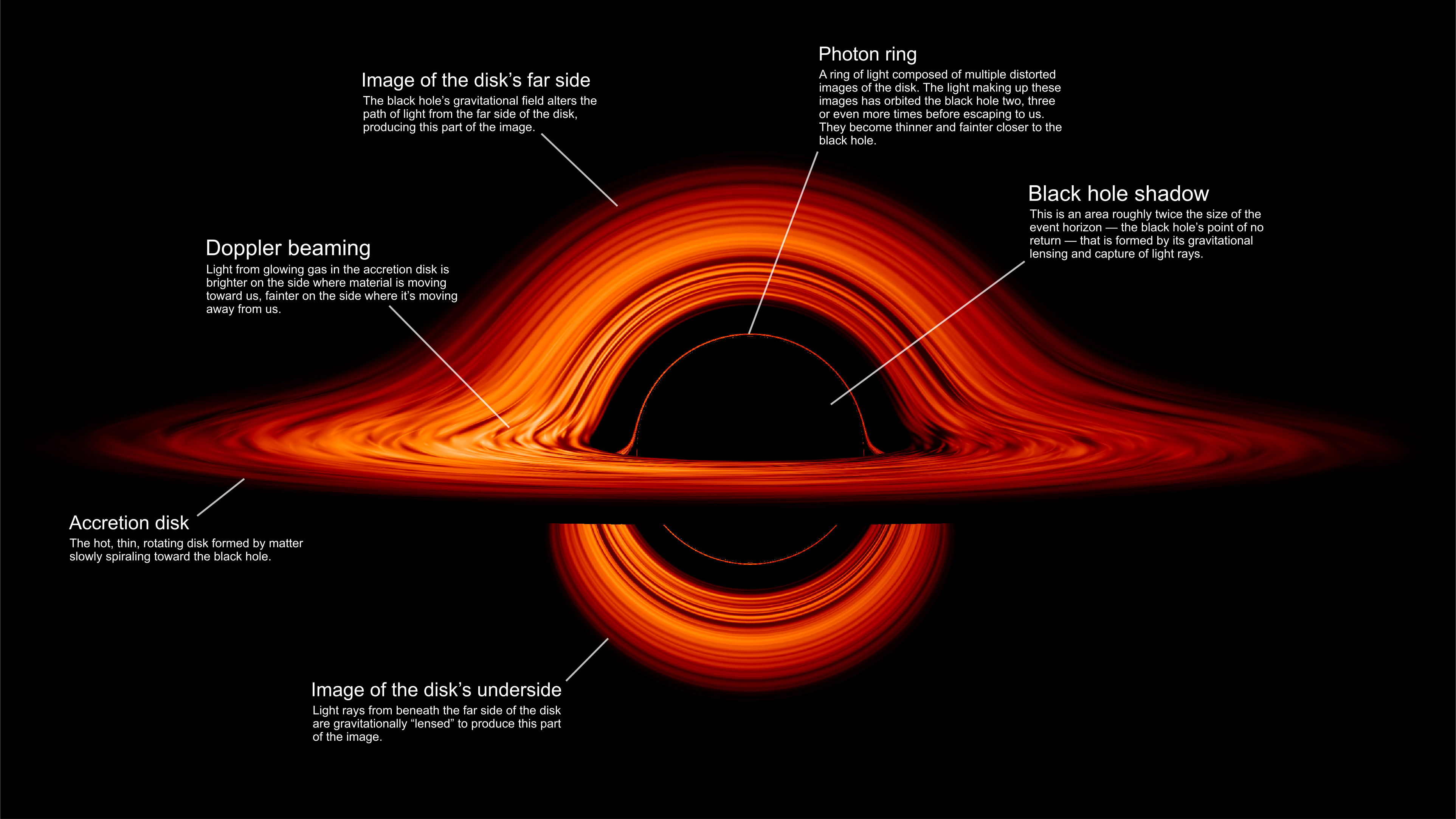
A scientific visualization of a black hole and its surrounding accretion disk, illustrating gravitational lensing, Doppler beaming, the photon ring and the black-hole shadow. The intense gravitational field bends light emitted from different regions of the disk, dramatically altering its apparent shape.
Image Credit: NASA’s Goddard Space Flight Center/Jeremy Schnittman
Imagine a container filled with liquid helium, cooled to an extraordinarily low temperature, just two degrees above absolute zero. Inside it, the liquid spins around a central point, forming a powerful whirlpool. Tiny waves travel across its surface, moving with and against the swirling flow.
At first glance, this might look like an unusual experiment in fluid mechanics. But something remarkable happens when scientists study how these waves behave. Under certain conditions, their motion begins to resemble the way waves behave near a rotating black hole.
It sounds like something from a science-fiction film, yet this is precisely the kind of phenomenon researchers have managed to investigate in a laboratory.
In March 2024, an international research team led by scientists at the University of Nottingham published a study in the journal Nature titled Rotating curved spacetime signatures from a giant quantum vortex. The researchers created an enormous vortex in an unusual form of liquid helium and investigated how waves travelled through its rotating flow. Their findings revealed striking mathematical similarities between the behaviour of these waves and certain processes associated with rotating black holes. [1]
The experiment connects two areas of physics that might initially seem unrelated: the strange behaviour of matter at extremely low temperatures and the physics of gravity in some of the most extreme environments in the Universe.
But before exploring this connection, we should address an important question: Did scientists actually create a black hole in their laboratory?
The answer is no. They did not create an object with enough gravity to trap light, nor did they bend the surrounding spacetime in the way a real black hole does. Instead, they created a physical system in which waves behave in ways that resemble some of the effects predicted by black-hole physics.
To appreciate why this is so fascinating, we first need to understand how a swirling liquid can have anything to do with gravity.
Can gravity really be simulated?
When we think about gravity, we usually imagine the force that keeps our feet on the ground, causes objects to fall, or holds planets in orbit around the Sun. For centuries, this was largely how gravity was understood.
Albert Einstein introduced a much deeper picture through his general theory of relativity. According to Einstein, gravity is connected to the shape, or geometry, of space and time. Together, space and time form what physicists call spacetime. Massive objects such as stars and planets change its geometry, and this influences how other objects and light move.
One of the most extreme consequences of this theory is the existence of black holes. A black hole is a region of spacetime surrounded by a boundary called the event horizon. Once light or another signal crosses this boundary inward, it cannot escape to the distant Universe. If the black hole is rotating, its spin also influences the surrounding spacetime, producing an effect known as frame dragging.
Now consider something much more familiar: a river flowing towards a waterfall.
Imagine a small wave travelling upstream. If the river is flowing slowly, the wave can move against the current. But as the water flows faster, the wave has increasing difficulty making progress. Eventually, the water may flow so quickly that the wave can no longer move upstream, even though it continues trying.
For the wave, this creates a kind of boundary beyond which escape against the current becomes impossible.

Image source: Braunstein, S. L., Faizal, M., Krauss, L. M., Marino, F. & Shah, N. A. (2023). Analogue simulations of quantum gravity with fluids. Nature Reviews Physics, 5, 612–622, Box 1.
Original publication: https://doi.org/10.1038/s42254-023-00630-y
Image retrieved from: Francisco R. Villatoro, La Ciencia de la Mula Francis, 26 August 2024.
In 1981, physicist William Unruh proposed that moving fluids could be used to reproduce some of the physics associated with black-hole horizons. Instead of studying light near a real black hole, scientists could study sound waves travelling through a flowing fluid. Under suitable conditions, the mathematical equations describing these two situations have important similarities. [2]
This idea became part of a field known as analogue gravity.
The word analogue is important. Scientists are not reproducing actual gravity in these experiments. They are recreating certain behaviours associated with gravity using a completely different physical system. By studying the similarities, researchers can investigate ideas that would otherwise be extremely difficult to test directly.
Why did scientists choose liquid helium?
Water is familiar to all of us. It flows, forms waves, and creates whirlpools. But water also experiences viscosity, a property that causes internal friction and gradually slows down moving fluid.
To study delicate wave patterns around a powerful vortex, scientists wanted a liquid with very different properties.
They turned to helium-4, a form of helium that becomes especially interesting when cooled to extremely low temperatures. Below approximately 2.17 kelvin, or about −271°C, liquid helium-4 enters a remarkable state called superfluidity.
In this state, part of the liquid can move without the ordinary internal friction associated with viscosity. Superfluid helium also displays unusual quantum behaviour that is normally associated with the microscopic world of atoms and particles.
However, superfluid helium is not simply a magical liquid in which all friction disappears. At temperatures above absolute zero, it contains both a superfluid component and a normal component. The normal component can still contribute to energy loss and resistance to motion.
In the Nottingham-led experiment, the helium was cooled to approximately 1.95 kelvin. At this temperature, the researchers could take advantage of its superfluid properties while creating and controlling a large rotating flow. [1]

Image credit: Leonardo Solidoro, University of Nottingham (2024).
Source: University of Nottingham, Quantum tornado provides gateway to understanding black holes, published on 20 March 2024.
https://phys.org/news/2024-03-quantum-tornado-gateway-black-holes.html
The real attraction of superfluid helium, however, goes beyond its unusual ability to flow. It also allows the formation of a special kind of whirlpool called a quantum vortex.
A giant whirlpool governed by quantum physics
We have all seen whirlpools, whether in a river, a bathtub, or water draining through a sink. The water rotates around a central region, and its speed changes depending on how far it is from the centre.
In an ordinary liquid, the strength of such rotation can vary continuously. A quantum superfluid behaves differently.
Its circulation, which describes the overall rotation around a closed path, can occur only in specific amounts. Rather than taking just any value, it comes in fixed units.
Physicists describe this through a simple equation:
Here, Γ represents the total circulation, κ represents one fundamental unit of circulation, and N tells us how many of these units are present.
Think of it like climbing a staircase. You can stand on the first step, the second step, or the third, but not on a step that does not exist between them. In a similar sense, the circulation around a quantum vortex occurs in discrete amounts rather than changing by arbitrarily small values.
This is what makes such vortices quantized.
The researchers managed to produce an exceptionally large vortex containing circulation equivalent to roughly 10,000 quantum units. That is a remarkable scale for a phenomenon governed by quantum mechanics. [1]
The experiment involved different arrangements of the circulating helium. In one configuration, the central region contained a compact collection of smaller vortices. Under different conditions, the researchers produced a larger, hollow central region around which the liquid circulated.

Image source: Švančara, P., et al. (2024). Rotating curved spacetime signatures from a giant quantum vortex. Nature, 628, 66–70, Figure 1.
Source: https://www.nature.com/articles/s41586-024-07176-8/figures/1
Licence of the scientific figure: Creative Commons Attribution 4.0 International (CC BY 4.0). https://creativecommons.org/licenses/by/4.0/
Presented as a screenshot of the original figure page.
Creating and maintaining such a large vortex was not straightforward. Quantum vortices can be unstable, and a large rotating structure may break apart into smaller ones. By carefully controlling how helium circulated through their experimental apparatus, the researchers succeeded in producing a sufficiently stable vortex for detailed measurements.
What makes this achievement particularly interesting is the connection between the quantum and everyday worlds. Although the circulation is governed by quantum rules, the large vortex can also be described using familiar ideas from classical fluid mechanics.
In other words, the experiment brought a fundamentally quantum phenomenon into a form large enough to investigate through the motion of ordinary-looking waves.
How can a swirling liquid imitate a rotating black hole?
This is where the connection to black holes becomes particularly fascinating.
Imagine dropping a small object into a gently flowing river. The object moves partly because of its own motion and partly because the river carries it along. Waves behave similarly: their movement depends not only on how quickly they travel through the water but also on how the water itself is moving.
Now replace the flowing river with a powerful whirlpool. Waves travelling around the whirlpool encounter different conditions depending on their direction. Some move along with the rotating flow, while others travel against it.
As a result, their paths, speeds, and frequencies can be affected by the surrounding fluid.
A rotating black hole also influences the behaviour of waves moving in its vicinity, although for a completely different reason. In that case, the effects arise from the geometry of spacetime around the rotating object.
What makes analogue gravity possible is that certain mathematical descriptions of wave motion in these two systems can resemble one another.
In the helium experiment, the researchers measured how the rotation of the fluid affected waves travelling across its surface. The flow could be described approximately as a combination of two types of motion: a broad rotation of the liquid and a circulation that becomes stronger closer to the centre of the vortex.
Together, these motions created conditions in which the surface waves displayed features reminiscent of waves travelling near rotating black holes.

Scientific reference: Švančara, P., et al. (2024). Rotating curved spacetime signatures from a giant quantum vortex. Nature, 628, 66–70.
Source of scientific reference: https://doi.org/10.1038/s41586-024-07176-8
Image credit: Original creator unverified. Conceptual illustration, not experimental data.
There is, however, an important limitation. Unlike the simplest theoretical models of analogue gravity, the measured helium waves did not all travel at the same speed. Their speed depended partly on their wavelength, an effect known as dispersion.
The researchers therefore used a more detailed description that accounted for the properties of the liquid, the depth of the helium, surface tension, gravity acting on the liquid, and the rotating flow itself. [1, 4]
This distinction matters because we should not imagine that the helium actually transformed the surrounding space into a miniature version of the spacetime around a black hole.
The liquid did not create real black-hole gravity. It created conditions in which certain waves behaved in mathematically similar ways.
That similarity is the entire foundation of the experiment.
What did the researchers actually observe?
Once the giant vortex had been created, the next challenge was to investigate the waves moving around it.
The researchers needed to measure extremely small disturbances on the surface of the liquid helium. These changes in height were tiny, sometimes approaching the scale of a micrometre, which is one-thousandth of a millimetre.
To make such precise measurements, they used an optical method involving carefully analysed patterns of light. By observing how these patterns changed with the movement of the liquid surface, they could reconstruct the shape and motion of the waves.
This allowed the researchers to study not only the waves themselves but also the rotating flow that influenced them.

Image source: Švančara, P., et al. (2024). Rotating curved spacetime signatures from a giant quantum vortex. Nature, 628, 66–70, Figure 2.
Source: https://www.nature.com/articles/s41586-024-07176-8/figures/2
Licence: Creative Commons Attribution 4.0 International (CC BY 4.0). https://creativecommons.org/licenses/by/4.0/
One particularly interesting observation involved waves that became confined between the outer wall of the experimental container and a region near the vortex that acted as a barrier to their motion.
Imagine sending a wave along a stretched rope that is fixed at both ends. Under suitable conditions, the wave reflects back and forth, creating a stable pattern in which some points move strongly while others hardly move at all.
A similar principle explains standing waves in musical instruments.
In the helium experiment, some waves formed comparable patterns around the rotating vortex. Rather than travelling freely through the entire liquid, they became trapped in particular regions. Scientists call these bound states.
The researchers measured the frequencies of these wave patterns and compared them with theoretical predictions. The agreement was encouraging: the observed behaviour followed the mathematical model of the rotating fluid remarkably well. [1]
This was more than a visual resemblance between a whirlpool and a black hole. It showed that the researchers could make meaningful predictions about wave behaviour and then test those predictions experimentally.
The surprising connection to black-hole ringdown
Imagine striking a bell. It begins to vibrate and produces a sound that gradually fades away. Although the sound becomes quieter, the bell continues vibrating at certain characteristic frequencies for a short time.
Something conceptually similar can happen when a black hole is disturbed.
For example, when two black holes merge, the newly formed black hole does not immediately settle into its final, stable state. It undergoes a period of oscillation, producing gravitational waves whose strength gradually decreases.
This final stage is known as black-hole ringdown.
The frequencies and decay rates of these oscillations depend on properties such as the black hole’s mass and rotation. By studying ringdown signals, physicists can learn about the object that produced them and test predictions of general relativity.

Image credit: Dr Keefe Mitman (Cornell University) and Professor Harald Pfeiffer (Albert Einstein Institute, Potsdam).
Source: University of Birmingham, published through EurekAlert! (2025).
https://www.eurekalert.org/multimedia/1090787
Could a laboratory vortex display something similar?
The Nottingham-led researchers investigated waves travelling against the direction of the rotating helium. They found that the behaviour of these waves changed depending on the structure of the central vortex.
In the hollow-core configuration, certain waves behaved differently from the trapped standing waves observed under other conditions. Instead of being confined in the same way, the waves showed enhanced activity near a particular region associated with the rotating flow.
One interesting feature appeared at a frequency of approximately 8.25 hertz, meaning about 8.25 oscillations every second.
The researchers interpreted these observations as possible signatures of wave behaviour analogous to black-hole ringdown. [1]
However, an important distinction must be made. They did not observe gravitational waves from an actual black hole, nor did they establish that their vortex possessed a genuine black-hole event horizon. The evidence pointed towards candidate analogue ringdown behaviour, which remains a more cautious and scientifically accurate description of the finding.
Even with that qualification, the result is significant. It suggests that a rotating quantum fluid can help scientists study certain wave processes that have close mathematical connections to the behaviour of black holes.
Could the experiment help us understand Hawking radiation?
Black holes are often described as objects from which nothing can escape. Yet in the 1970s, Stephen Hawking showed that quantum theory leads to a remarkable prediction: black holes should emit a faint form of radiation.
Today, this is known as Hawking radiation.

Scientific reference: Hawking, S. W. (1975). Particle creation by black holes. Communications in Mathematical Physics, 43, 199–220.
DOI: https://doi.org/10.1007/BF02345020
The prediction emerges from the behaviour of quantum fields in the presence of a black-hole horizon. It connects gravity, quantum physics, and thermodynamics, making it one of the most important theoretical discoveries in modern gravitational physics.
Unfortunately, Hawking radiation from ordinary astrophysical black holes is extraordinarily difficult to detect directly.
This is one reason scientists are interested in analogue-gravity experiments. If a laboratory system can reproduce some of the mathematical conditions associated with a black-hole horizon, it may be possible to investigate related wave and quantum effects in a much more accessible environment.
There is another fascinating process associated with rotating black holes, known as superradiance.
Under suitable circumstances, a wave interacting with a rotating black hole can emerge with more energy than it had before the interaction. The additional energy comes from the black hole’s rotation.
A rotating fluid can, in principle, support related forms of wave amplification.
The giant quantum vortex offers a promising system for investigating such possibilities. However, the 2024 experiment did not directly observe Hawking radiation or demonstrate superradiance. It also did not directly establish the presence of an analogue of the special region surrounding a rotating black hole where rotational effects become particularly important, called an ergoregion. [1]
These remain potential directions for further experiments.
The distinction is essential: discovering a system capable of investigating a phenomenon is not the same as demonstrating that the phenomenon has already occurred.
Does this experiment bring us closer to understanding quantum gravity?
Modern physics rests heavily on two extraordinarily successful theories.
The first is Einstein’s general relativity, which describes gravity and the behaviour of spacetime. The second is quantum theory, which describes matter and physical processes at extremely small scales.
Both have passed countless experimental tests, yet bringing them together into a complete theory remains one of the greatest challenges in physics.
This unresolved problem is commonly called quantum gravity.

Scientific reference: Barceló, C., Liberati, S., & Visser, M. Analogue gravity. Living Reviews in Relativity.
Note: This is a conceptual representation, not an experimentally verified picture of the quantum structure of spacetime.
The difficulty becomes especially important when considering environments such as the earliest moments of the Universe or regions where the effects of strong gravity and quantum physics may both become essential.
At first, an experiment involving superfluid helium might seem like a promising shortcut towards solving this problem. After all, the fluid is a quantum system, and the waves can behave in ways that resemble aspects of curved spacetime.
But the relationship is more subtle.
The experiment does not show that gravity itself is produced by a quantum fluid, nor does it demonstrate that spacetime is made from the same kind of material. It also does not provide a complete theory combining quantum mechanics with Einstein’s gravity.
What it does demonstrate is that different physical systems can share important mathematical structures.
This is valuable because scientists can sometimes investigate a difficult theoretical problem by studying a more accessible system that follows similar equations. Analogue-gravity experiments allow researchers to explore how waves respond to effective horizons, rotation, and other features associated with gravitational physics. [3]
Such experiments cannot replace observations of actual black holes or a fundamental theory of quantum gravity. But they can help scientists test ideas, understand the importance of underlying assumptions, and examine how certain effects behave in conditions that would be impossible to reproduce using real astrophysical objects.
Their importance lies not in solving quantum gravity directly, but in providing another way to investigate some of the questions surrounding it.
Why is this discovery important?
The real achievement of the Nottingham-led experiment is not simply that scientists created an impressive whirlpool. It is that they developed a controllable laboratory system in which several interesting aspects of rotating-wave physics could be investigated experimentally.
First, they demonstrated that a giant quantum vortex containing thousands of circulation quanta could be maintained in superfluid helium.
Second, they developed a way to measure extremely small surface waves and use those measurements to understand the rotating flow.
Third, they observed wave patterns whose frequencies agreed with theoretical predictions. They also found intriguing evidence suggesting behaviour analogous to black-hole ringdown.
Together, these achievements provide researchers with a new experimental platform for exploring the connection between fluid motion and gravitational-wave mathematics. [1]
There are still many unanswered questions. Could future versions of the experiment produce clearer evidence of analogue ringdown? Would stronger or differently controlled flows allow scientists to investigate wave amplification? How closely can laboratory wave systems reproduce the behaviour expected near black holes?
There are also important limits to the comparison. Real black holes involve the geometry of spacetime itself, while the laboratory experiment involves waves moving through a material. Understanding exactly where the similarities begin and end is essential.
Future experiments may therefore be as valuable for revealing the limitations of analogue gravity as they are for demonstrating its possibilities.
That is how scientific progress often works. A successful experiment does not necessarily provide the final answer. Sometimes, its greatest achievement is opening a new way to ask questions that were previously difficult to investigate.
The deeper lesson: when different worlds follow similar rules
A rotating whirlpool and a black hole seem to have almost nothing in common.
One is formed from a liquid inside a laboratory. The other is an extreme region of spacetime, often created through the gravitational collapse of a massive star or formed through other astrophysical processes.
Their physical origins are completely different. Yet under suitable conditions, the mathematical rules governing certain waves in these two environments can show remarkable similarities.
This is one of the beautiful aspects of physics. Nature does not always arrange its phenomena into entirely separate categories. Sometimes, ideas developed to understand one part of the Universe unexpectedly become useful in another.
The giant quantum vortex experiment is a striking example of this connection.
It does not mean that scientists have created an actual black hole, discovered the fundamental structure of spacetime, or solved the mystery of quantum gravity. Its achievement is more specific, but no less interesting: researchers have shown that a carefully controlled quantum fluid can reproduce aspects of wave behaviour associated with rotating gravitational systems.
For scientists, this offers a new experimental approach to studying difficult theoretical ideas. For the rest of us, it provides a reminder that the Universe can reveal surprising connections between things that appear entirely unrelated.
We do not always need to recreate an entire physical object to understand some of the rules that govern its behaviour.
Sometimes, a phenomenon as familiar as a swirling liquid can offer an unexpected window into the physics of black holes.
And perhaps that is what makes this experiment so fascinating: a small laboratory on Earth can help us explore mathematical ideas connected to some of the most extraordinary objects in the Universe.
References and Further Reading
- Švančara, P., Smaniotto, P., Solidoro, L., MacDonald, J. F., Patrick, S., Gregory, R., Barenghi, C. F., & Weinfurtner, S. (2024). Rotating curved spacetime signatures from a giant quantum vortex. Nature, 628, 66–70. https://doi.org/10.1038/s41586-024-07176-8
- Unruh, W. G. (1981). Experimental black-hole evaporation? Physical Review Letters, 46, 1351–1353. https://doi.org/10.1103/PhysRevLett.46.1351
- Barceló, C., Liberati, S., & Visser, M. (2026). Analogue gravity. Living Reviews in Relativity, 29, Article 2. https://doi.org/10.1007/s41114-026-00064-9
- Švančara, P., et al. (2024). Rotating curved spacetime signatures from a giant quantum vortex. arXiv preprint, arXiv:2308.10773, Version 4. https://arxiv.org/abs/2308.10773
- Braunstein, S. L., Faizal, M., Krauss, L. M., Marino, F., & Shah, N. A. (2023). Analogue simulations of quantum gravity with fluids. Nature Reviews Physics, 5, 612–622. https://doi.org/10.1038/s42254-023-00630-y
- LIGO Scientific Collaboration, Virgo Collaboration, & KAGRA Collaboration. (2026). Black hole spectroscopy and tests of general relativity with GW250114. Physical Review Letters, 136, 041403. https://doi.org/10.1103/6c61-fm1n
- Hawking, S. W. (1975). Particle creation by black holes. Communications in Mathematical Physics, 43, 199–220.https://doi.org/10.1007/BF02345020
Note: Reference [4] is the freely accessible manuscript corresponding to the research published in Reference [1], rather than an independent experimental study.